CANM computes outdoor propagation by the engineering method of
ISO 9613-2:2024, and is built
throughout on the 24 published standards and guidelines named here.
Every term is the equation the standard gives; every report names the clause behind it.
ISO 9613-2:2024ISO 9613-1:1993CNOSSOS-EUISO/TR 17534-4:2020ECAC Doc 29ICAO Doc 9911SAE-AIR-1845SAE-AIR-5662SAE-ARP-866ABS 4142ISO 1996-1 / ISO 1996-2IEC 61672-1:2013Directive 2002/49/ECSRTM / Copernicus DEMBS 5228-1BS 8233:2014IFC EHSDIN 18005-2 / NF S 31-130ISO 3744ISO 3746ISO 8297EN 1793-1 / EN 1793-2ISO 10140ICAO Annex 16
COMMONQUESTIONS
Both exist in the tool and you choose per project. IFC EHS Table 1.7.1 is what lender-financed work is usually judged against. TZS 932:2017 is the national standard: Table 1.1 for the general environment, Table 1.8 for aerodromes. They are not interchangeable - TZS 932 runs day from 06:00 where IFC runs it from 07:00, and its industrial night limit is 60 dB(A) against IFC's 70. A site judged against the wrong one can pass by 10 dB. For anywhere else, the third scheme is blank and you enter the limits from the regulation, which the report then cites.
Usually neither - they are answering different questions. A prediction is the specific sound from the sources you modelled; a measurement is everything audible at that spot, including traffic, insects, wind and the neighbours. Compare like with like: record the residual with the source off, or model every source that was running. If they still differ, the sound power is the first thing to check - it is the input that moves every receiver by the same amount in the same direction, which is the hardest error to see.
Best is the manufacturer's declared value or a test report to ISO 3744. Next best is your own meter reading: use the "L_w from measurement" option, give the level, the distance and the surface you measured over, and it converts for you. Do NOT type a measured dB(A) straight into the sound power field - at 5 m over hard ground that overstates the source by about 22 dB. Whatever you use, the method is recorded against the source and appears in the report, so a reader can see which figures were measured and which were assumed.
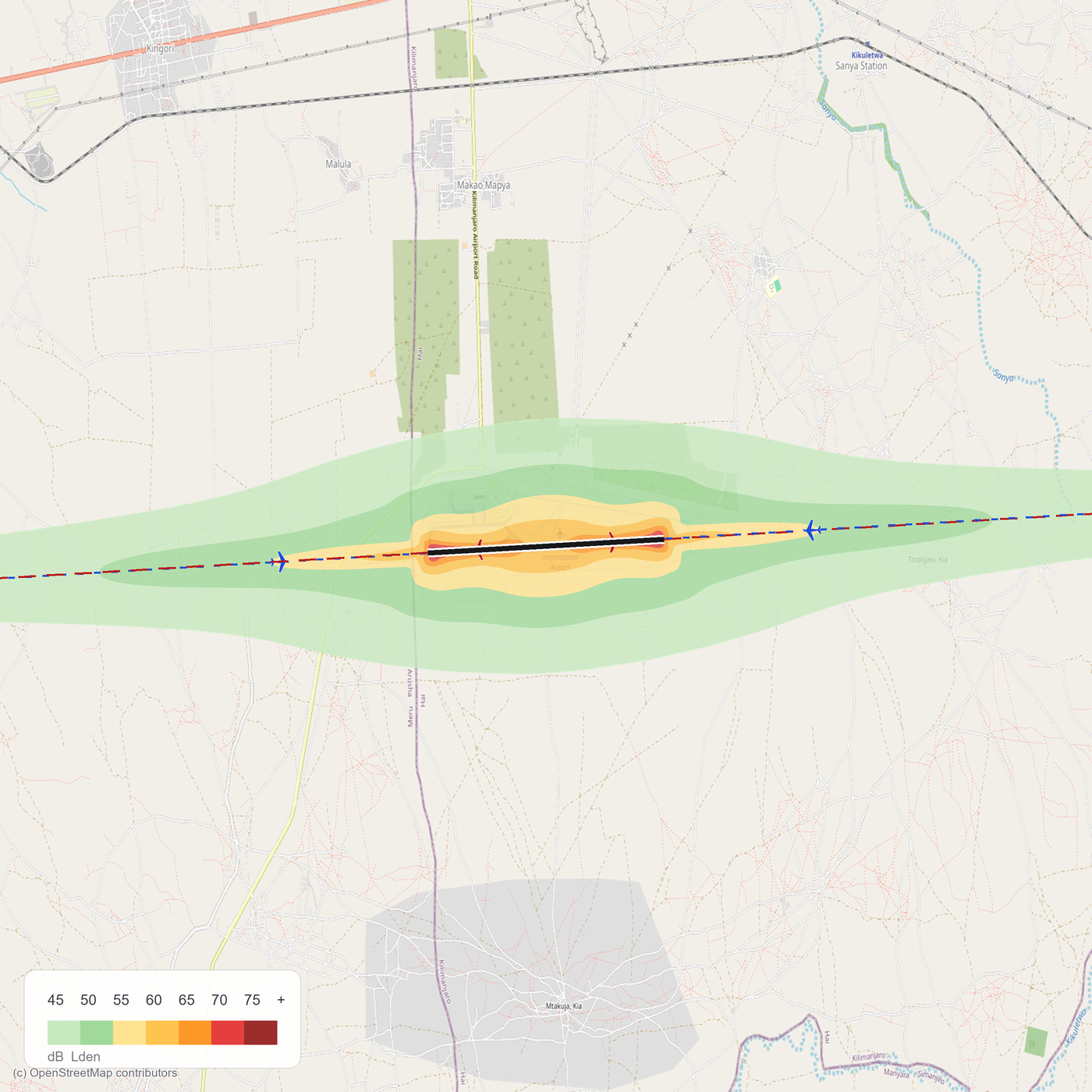
Yes, and that is what it is built for. The propagation is ISO 9613-2:2024, aircraft is ECAC Doc 29 4th edition, and every attenuation term in the report is traceable to the clause it came from. TZS 932 Annex B.4 sets out what a compliance report must contain and it allows the result to come from calculation as well as measurement, provided the method is stated - item (g) covers measurements or calculations and item (i) requires the calculation method. The report states it.
ISO 9613-2 states its own accuracy in clause 9: about plus or minus 1 dB for a source and receiver both under 5 m high within 100 m, widening to about plus or minus 3 dB at greater heights and distances. That is the method's figure, not ours, and no implementation beats it. In practice the inputs move the answer more than the propagation does - a sound power out by 3 dB moves every receiver by 3 dB.
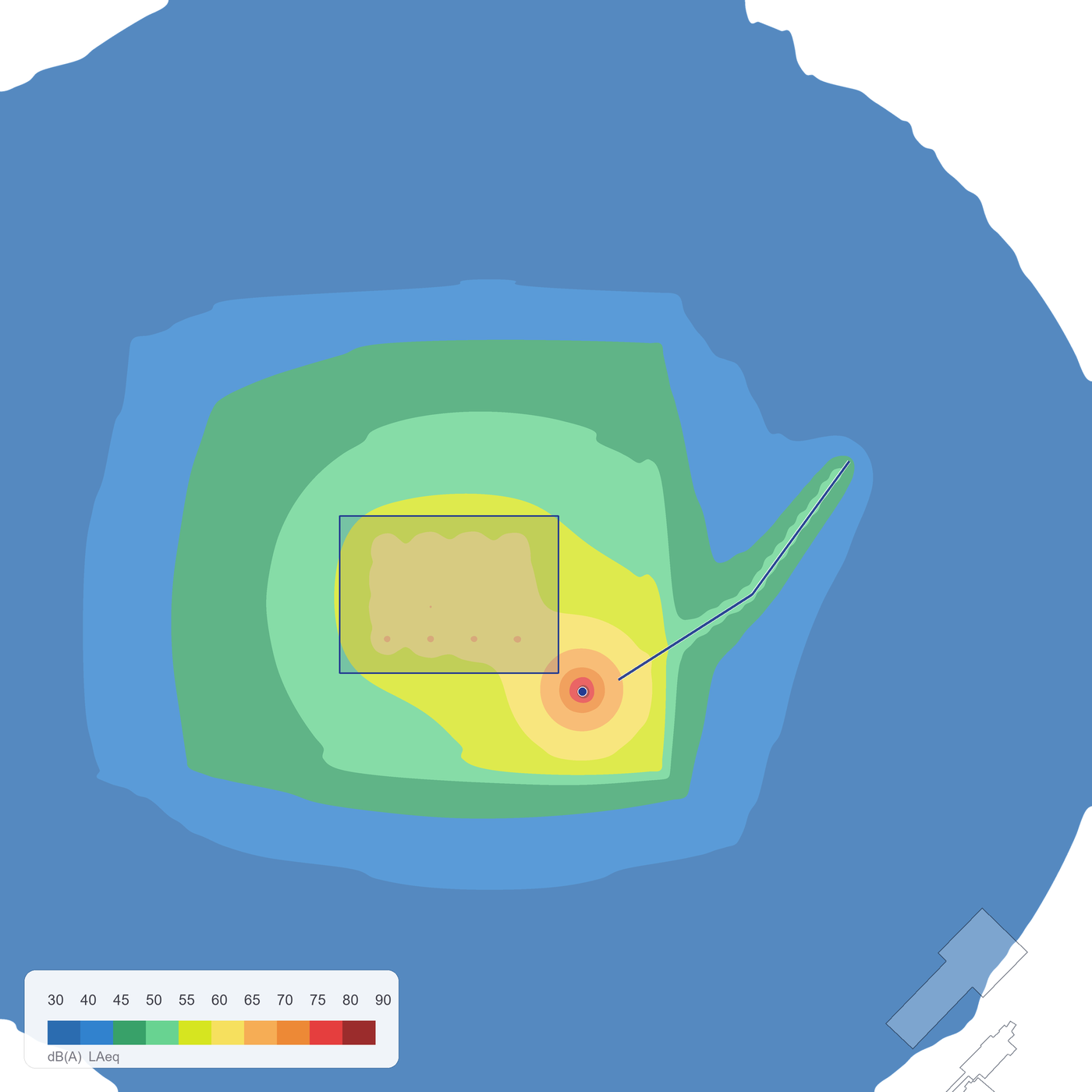
Yes, through a separate airblast model - not the propagation engine, because a blast breaks every assumption that engine makes. Airblast is predicted from the cube-root scaled distance, SD = D / W^(1/3), after USBM RI 8485: give it the charge weight per delay and the distance and it returns the peak overpressure, and it will also invert that to tell you the largest charge per delay that still meets a limit at a given receiver, which is the number that goes on the blast plan. One thing it will not do is compare across weightings. TZS 932 Table 1.4 is written in dB(C) while the published coefficients predict an unweighted peak, and those differ by tens of decibels for the same shot - so to assess against Table 1.4 you monitor that site in dB(C) and fit its own site factors, which is what the USBM method asks for anyway. Three monitored shots is the minimum; the fit reports its scatter so you can work to a 95 per cent figure rather than a median that is exceeded half the time. Everything else at a quarry - crushers, screens, conveyors, haul roads - is ordinary continuous plant, and goes through the propagation model against Table 1.1.
Yes - that is the inverse of the same relationship, so it cannot disagree with the forward prediction. Give it the distance to the nearest protected receiver and the limit, and it returns the largest charge per delay that meets it. Ask for the 95 per cent figure rather than the median: airblast scatters shot to shot with stemming, burden and above all the weather, and a median prediction is exceeded half the time by construction, which is not a basis for saying a limit is met.
Not as part of the specific sound. Under BS 4142 the sound under investigation is the plant, and public road traffic belongs to the background - including it inflates both the rating level and the residual and flatters the comparison. Model the road separately if you need the ambient, or better, measure the residual. The two jobs are kept apart in the tool for this reason.
Whichever your sources actually operate in, and often both. The night limit is 10 to 15 dB lower depending on the scheme, so a plant that passes comfortably by day can fail at night without changing anything. The model will not decide it for you, because whether a machine runs at night is an operational fact rather than an acoustic one - set the duty cycle for the period you are assessing.
A multi-point shape does not exist until you press FINISH. Click each corner of the area, line or barrier, then press the green Finish button, or just hit Enter. Until then the points on screen are a drawing in progress rather than a saved object, so nothing appears in the list on the left and a solve has nothing to work from. This is the single most common reason a first model comes back empty.
Both, for different jobs, and never interchangeably. LA90 is the quiet floor exceeded 90% of the time and is what BS 4142 compares a rating level against. LAeq is the energy average and is what a new source is added to when working out the resulting ambient. In a varying environment LAeq sits several dB above LA90.
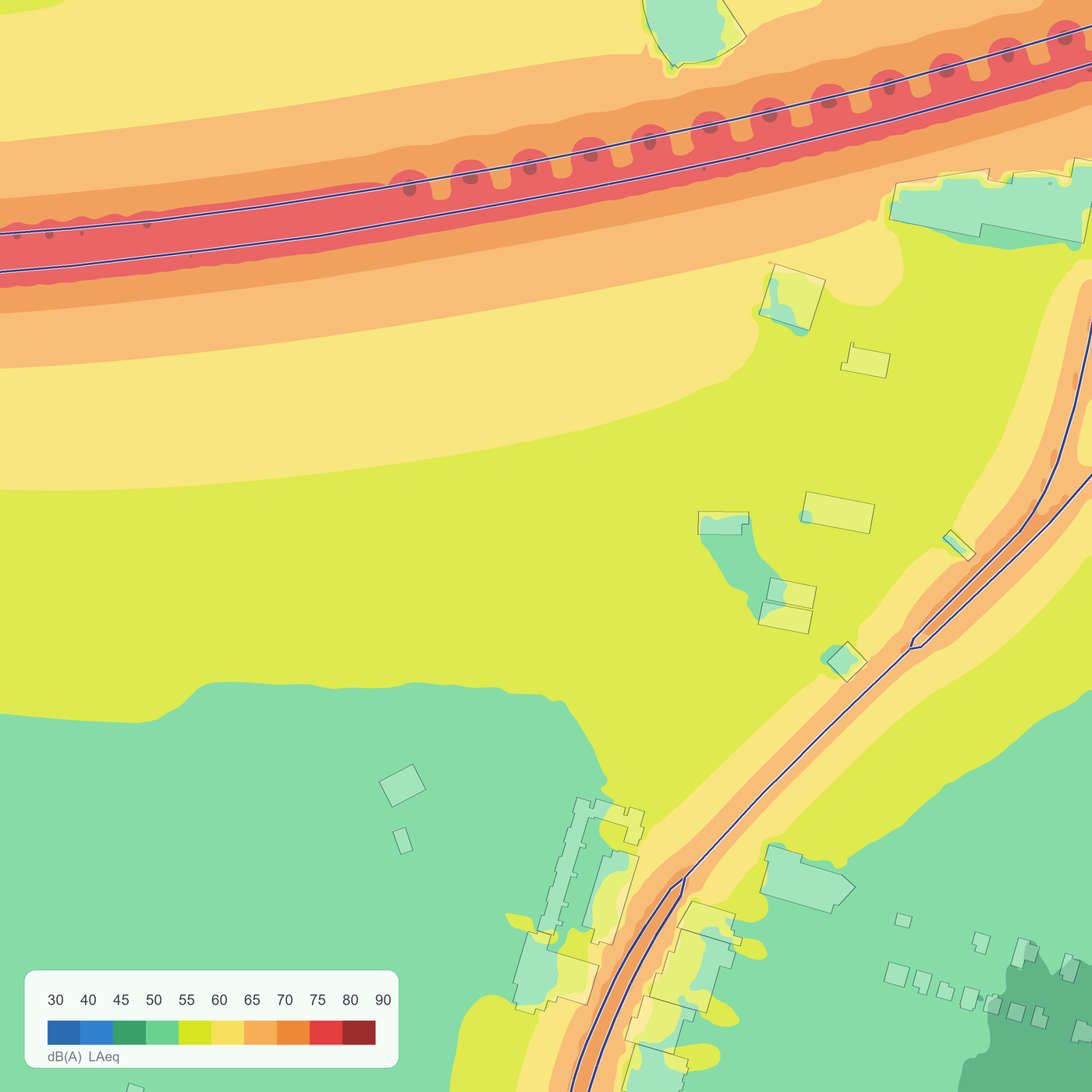
Only what it adds to the screening the path already has, which is often far less than the datasheet suggests. On one real site a 5 m screen was worth 19 dB across open ground and 0.43 dB behind a block that already broke the line of sight. Draw the barrier, then switch it off in a second scenario - the difference between the two is the only figure worth quoting. And extend it well past both ends, or the sound simply goes around.
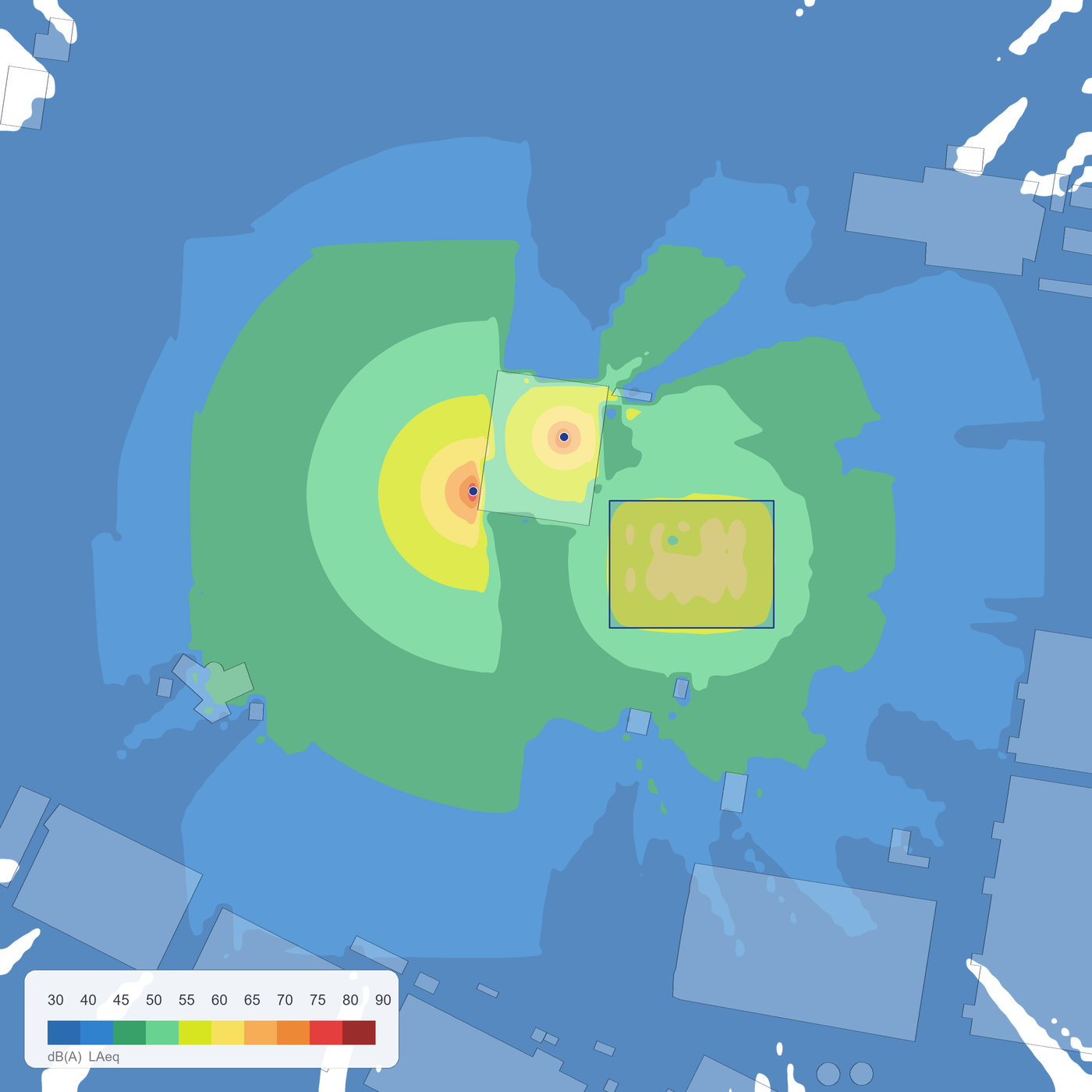
Leave them in. On a dense site the imported buildings were worth 4.4 dB of screening on average across the whole grid. Deleting them makes the solve faster and the site much louder at the same time, which is the wrong trade in both directions.
Yes - shapefile as a .zip, GeoJSON, KML or GeoPackage. Runways, roads, buildings, a mine or quarry boundary. Include the .prj file: a file that does not declare its coordinate system is refused rather than assumed to be latitude and longitude, because reading UTM metres as degrees puts the whole site somewhere else without anything on screen to say so. The preview shows each feature's distance from your site before anything is written.
Out of scope here - this model is airborne sound. Ground-borne vibration is a separate measurement and, in Tanzania, a separate standard (TZS 1471). Blast vibration in particular is monitored with a geophone, not predicted from a noise model.
The run was computed before a change that moves levels. Every run records the method revision that produced it, and the report compares that against the current one. Re-run the calculation before issuing anything from it.
On a dense site with many sources and buildings, yes - around five minutes is typical, and it is the work itself rather than waste. The two biggest controls are the size of the calculation area and the screening search radius in Site settings. The live preview stays fast regardless; it is the final raster that is heavy. Accuracy is not traded for speed here, which is a deliberate choice for work that has to be defended.